It is 9:40 in the morning and the math lesson has started twice. The first start ended at the bookshelf, which the toddler has learned to climb. The second ended at the sound of a cereal box being emptied into the couch cushions, slowly, with real satisfaction.
Maybe your version is different. The pot drawer, a roll of toilet paper, the dog's water bowl. Every house with a toddler in it has a version.
And somewhere past the second start a quiet thought shows up: I cannot actually teach school like this.
I want to sit with you in that thought for a minute, because I homeschooled with a toddler underfoot for most of twenty years. Eight children, spread across two decades. The toddler season was not a stage I pushed through to get to the real homeschooling. Most years, it was the homeschooling.
I did not get through those years by trying harder at the plan I already had. I got through them by dropping two expectations - and replacing them with something better. Here they are.
I stopped expecting long lessons
With a toddler in the house, I was not going to be able to sit with a school-aged child for an hour of anything. So I stopped expecting to.
Ten minutes here and there were enough. And we still got through.
I want to say that second part again, because it is the part the 9:40 version of you doubts: we still got through. The curriculum got finished. The children got educated. Four of them have graduated now, and plenty of their lessons happened ten minutes at a time with somebody small in the room.
A lesson does not stop counting because it happens in pieces. Ten focused minutes at the table, a pause for whatever is happening in the couch cushions, ten more minutes when the dust settles. By the end of the morning that is a math lesson. It just happened the way everything happens in a toddler house - in pieces, with interruptions, adding up anyway.
If you only change one thing this week, change the unit of measure. Stop asking whether you got an hour. Ask whether you got ten minutes, a few times. At the end of the week, count what actually got done - the pieces hold more than the empty boxes admit.
I stopped expecting a clean house all the time
The second expectation I dropped was the clean house. Not a clean house ever - a clean house all the time.
A house where children live and learn all day gets used all day. The table that holds the math also holds the lunch, the read-aloud, and the project nobody asked about. At any random hour of a school day, a homeschool house looks like what it is: a place where a lot of living is happening at once.
The expectation I dropped was the all the time - the idea that the house should be ready for company at eleven on a Tuesday morning. It did not need to be. The house got cleaned. It just was not clean at every moment, and I stopped reading the middle of the day as a verdict on my housekeeping.
That one took longer to drop than the lessons, if I am honest. But a midday mess is not a sign the day is failing. Most days it is the evidence that the day is happening.
What replaced them: half-hour blocks
Here is the part I most want to hand you, because dropping those expectations was not lowering the bar. What replaced them was more structure, not less.
I got my act together and scheduled our days down to half-hour blocks. Thirty minutes at a time, the whole day accounted for. Some blocks were older children having time with younger ones. Some were independent play. Some were helping me in the kitchen.
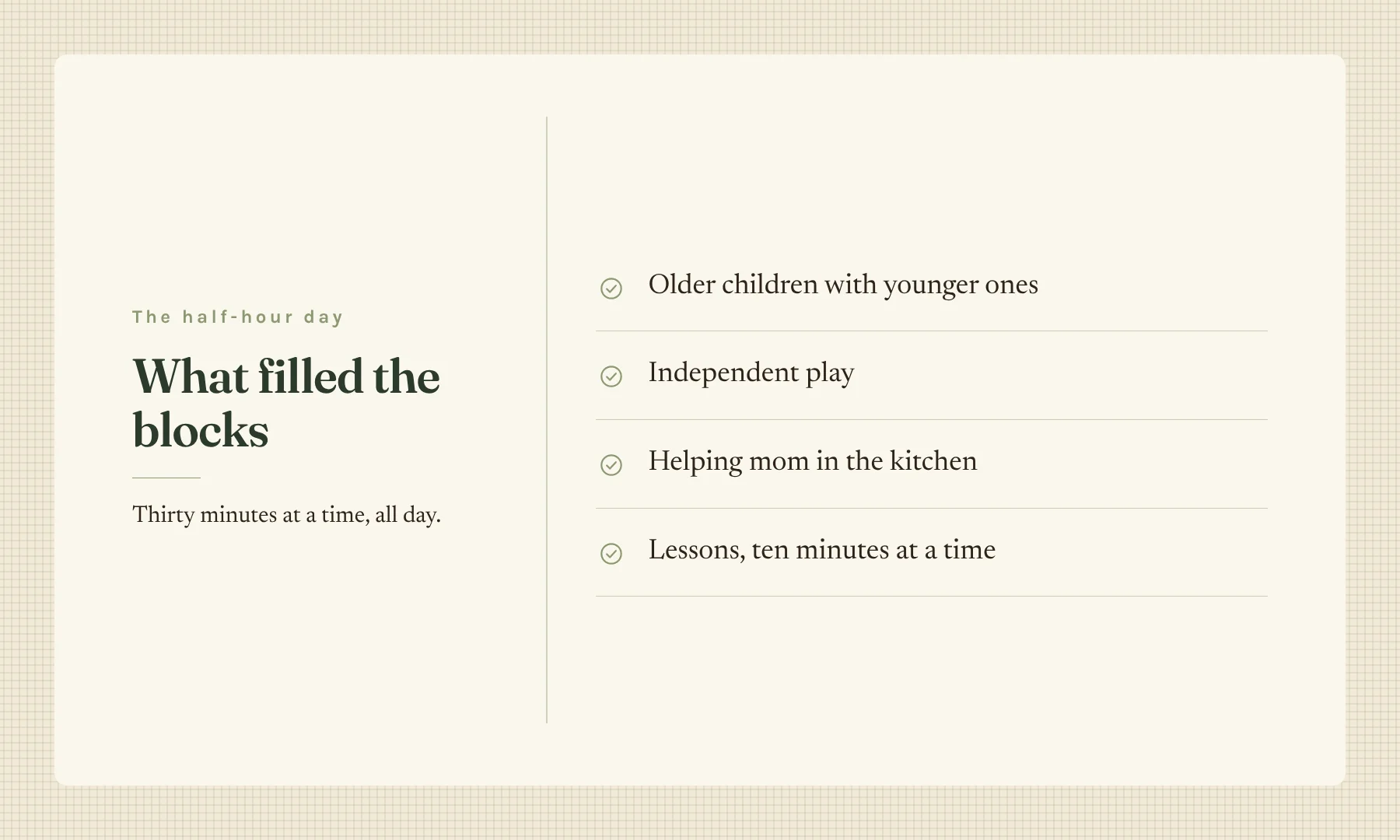
Notice what that schedule assumes. It does not assume a quiet morning. It does not assume an uninterrupted hour, because there was never going to be one. It assumes a toddler - and then it gives the toddler somewhere to be: with a big sister, in the play corner, in the kitchen with me.
The toddler was not an interruption to the schedule. The toddler was in it.
A half-hour block is honest about a toddler house in a way an hour-by-subject grid never was. If your August plan assumed long, quiet stretches at the table, it was built for a family that does not live at your house - and when the plan stops describing your life, the plan failed. You did not. Write the smaller blocks. Put the toddler in them.
Perfection was the real expectation
Both of those expectations were really one expectation. I stopped expecting perfection with a toddler in the house.
Long lessons and a spotless eleven o'clock house are both pictures of a homeschool where nothing ever interrupts. That homeschool does not exist. It never did. And a toddler is simply the member of the family whose job is to make sure you know it.
What you can have is a day with a shape to it. Ten minutes that count. Blocks that already know who is holding the baby. A house that gets cleaned without being a shrine. Faithful, in other words - not perfect, because the toddler years run on faithful.
So if it is 9:40 and the cereal is in the couch and the math has started twice: nothing about your morning says this cannot be done. It says the hour-long version cannot be done. Drop the two expectations. Keep the ten minutes. Give the toddler a block of her own.
We are getting ready to open, and the founding list is how you hear first. Short letters, and nothing else. If you want in early, join the founding list. And if you know a mom deep in the toddler years who thinks she is the only one teaching in ten-minute pieces, send her this letter.
Tina